Why Verified Student Creators for Colleges Work
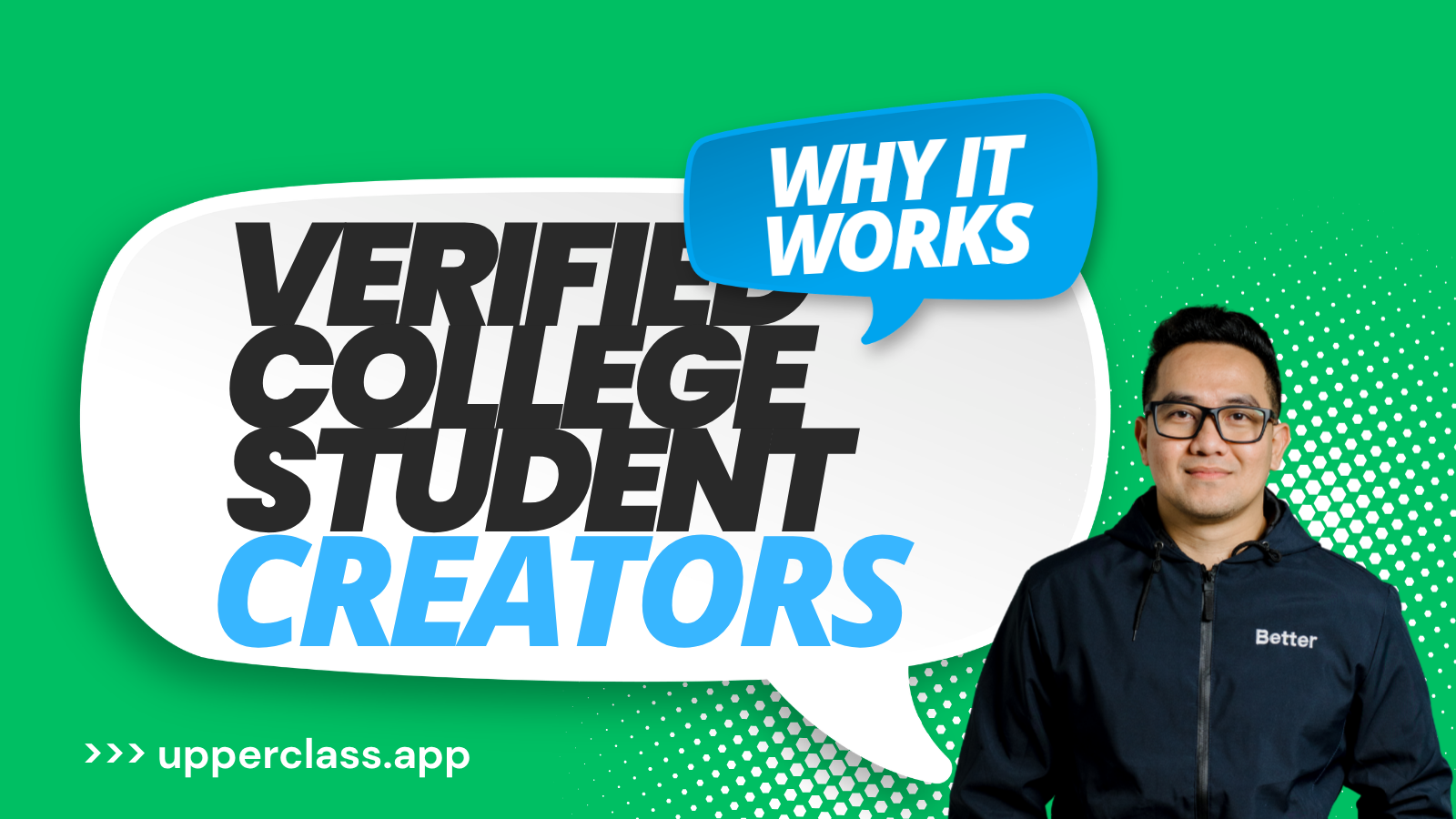
Verified student creators for colleges help enrollment teams build trust, reach prospects earlier, and turn authentic student voices into applications.
A campus tour guide can say the food is good, the dorms are social, and the professors are accessible. A current student creator can show it in 15 seconds - and prospects will believe them faster. That is why verified student creators for colleges are becoming a serious enrollment strategy, not just a social media experiment.
Higher ed marketing has a trust problem. Institutional messaging still matters, but polished copy and brand videos do not carry the same weight they once did. Prospective students want proof. They want to hear from someone living the experience right now, on the platforms they already use, in a voice that feels real. The catch is that authenticity without structure creates risk. That is where verification changes the equation.
What verified student creators for colleges actually solve
Most colleges already have students posting about campus life. The issue is not whether student content exists. The issue is whether enrollment teams can identify the right creators, confirm they are who they say they are, and activate them consistently without turning the process into chaos.
Verified student creators solve three problems at once.
First, they close the credibility gap. When a prospective student sees content from a real, current student with a confirmed connection to the institution, the message lands differently. It feels less like advertising and more like trusted guidance.
Second, they make student advocacy operational. Without verification and structure, student content is random. A few great posts might appear during move-in week or basketball season, but there is no repeatable system behind them. Enrollment teams need more than occasional organic wins. They need a channel.
Third, they reduce brand and compliance risk. Not every student with a following is the right fit for recruitment. Verification helps institutions confirm student status, filter for alignment, and work with creators in a more accountable way.
Why verification matters more than follower count
A common mistake in creator marketing is overvaluing reach and undervaluing relevance. In college recruitment, a creator with 2,500 engaged followers who genuinely documents campus life can be more influential than a lifestyle creator with 50,000 followers and little connection to the student decision journey.
Verification sharpens that distinction. It tells enrollment teams they are not just buying attention. They are activating real student perspective.
That matters because prospective students are not looking for entertainment alone. They are trying to answer high-stakes questions. What does a normal day look like? Are students like me finding community here? Does this place feel energizing, stressful, welcoming, competitive, affordable? Those questions are rarely answered by polished institutional content. They are answered by the students already living on campus.
Verification also protects against a quieter issue: misrepresentation. If a creator is no longer enrolled, barely engaged on campus, or posting a version of student life that does not reflect reality, the institution loses message control without gaining trust. Verified creator programs are built to prevent that trade-off.
The real recruitment value is earlier influence
Too many colleges think about student creators as a conversion tactic near the end of the funnel. They are useful there, but their biggest value often shows up earlier.
Verified student creators influence awareness and consideration before a prospect fills out a form, starts an application, or attends an event. They shape perception while students are still deciding which schools feel worth learning more about.
That timing matters. By the time a prospect reaches an admissions page, many opinions are already formed. They have watched day-in-the-life videos, compared social feeds, scanned comments, and paid attention to how current students talk about the institution when no one from marketing is visibly in charge.
A verified creator strategy gives colleges a way to participate in that stage with more credibility than a branded campaign alone can deliver.
What strong verified student creator programs look like
The best programs are not built around one viral post. They are built around repeatable student-led storytelling.
That means colleges need creator coverage across different identities, interests, and experiences. One student cannot represent the whole institution. A nursing major, a transfer student, an international student, a first-generation student, and a student athlete may all speak to very different prospect concerns. That variety is where creator programs become more than content production. They become a recruitment asset.
Strong programs also give creators enough direction to stay aligned without scripting them into irrelevance. That balance is critical. If the institution controls every word, the content loses what made it persuasive in the first place. If there is no structure, quality and consistency fall apart. The best approach sits in the middle: clear goals, useful prompts, trusted creators, and room for real student voice.
Where colleges get this wrong
The first mistake is treating student creators like interns with phones. If the work is valuable enough to influence enrollment, it needs strategy, standards, and support.
The second is confusing testimonials with creator content. A testimonial is typically static, polished, and retrospective. Creator content is ongoing, platform-native, and built for how prospects actually consume information. One says, this student likes our school. The other shows why a prospect might see themselves there.
The third is underestimating scale. One or two student ambassadors may work for a campus visit day. They do not create enough content velocity to compete in a crowded digital environment. Colleges need a reliable way to identify, verify, organize, and activate creators over time.
The fourth is assuming every creator program should look the same. It depends on institutional goals. A regional public university trying to improve local yield may prioritize highly relatable campus-life content. A globally recruiting institution may need creators who can speak to transition, belonging, and academic ambition for audiences far beyond its immediate market.
Verified student creators for colleges and enrollment performance
The strategic case is simple. Trusted voices drive attention better than controlled messaging alone, and attention without trust rarely converts.
Verified student creators for colleges help bridge that gap by making peer influence usable inside an enrollment strategy. They can support paid social creative, organic content, event promotion, admitted student engagement, and one-to-one prospect outreach. Their value is not limited to one channel because their credibility travels.
This is especially relevant for enrollment teams under pressure to do more with the same resources. Traditional campaigns are getting more expensive. Organic brand content is harder to sustain. Student creators offer a different kind of leverage: authentic content, native distribution, and stronger social proof.
That does not mean creator-led recruitment replaces every existing tactic. It means the mix shifts. Brand messaging still sets institutional positioning. Admissions counselors still guide decision-making. Campus visits still matter. But verified student creators add something the rest of the stack cannot easily replicate - believable proximity to the actual student experience.
Building a program that admissions teams can trust
For many institutions, the hesitation is not about value. It is about execution. Who are these students? How are they vetted? How do we keep content aligned with institutional priorities without stripping away authenticity?
Those are the right questions.
A credible program starts with identity and enrollment verification. It then moves into creator fit, content expectations, communication workflows, and appropriate guardrails. Teams should know who is representing the institution, what kinds of stories they are equipped to tell, and how success will be measured.
Measurement should also go beyond vanity metrics. Views matter, but they are not enough. Institutions should pay attention to engagement quality, saves, shares, direct messages, event interest, application starts, and how creator content performs across the student journey. The goal is not just to be seen. It is to influence action.
This is where a dedicated platform approach becomes more practical than ad hoc coordination through spreadsheets and emails. UpperClass, for example, is built around this exact need: helping colleges activate verified student creators as a structured recruitment channel rather than a scattered content effort.
What this signals about the future of college marketing
The shift toward student-led recruitment is not a trend line to watch from a distance. It is a response to how trust now works.
Prospective students want proximity to real experience. They want less institution-speak and more evidence. Colleges that treat verified creators as a strategic layer in recruitment will move faster than institutions still relying on top-down messaging to do all the work.
The advantage is not just authenticity. It is operational authenticity - student voice that is credible, organized, and usable at scale.
For enrollment teams, that is the real opportunity. Not more content for content’s sake. More trust where decisions actually start.