
UpperClassUpperClass
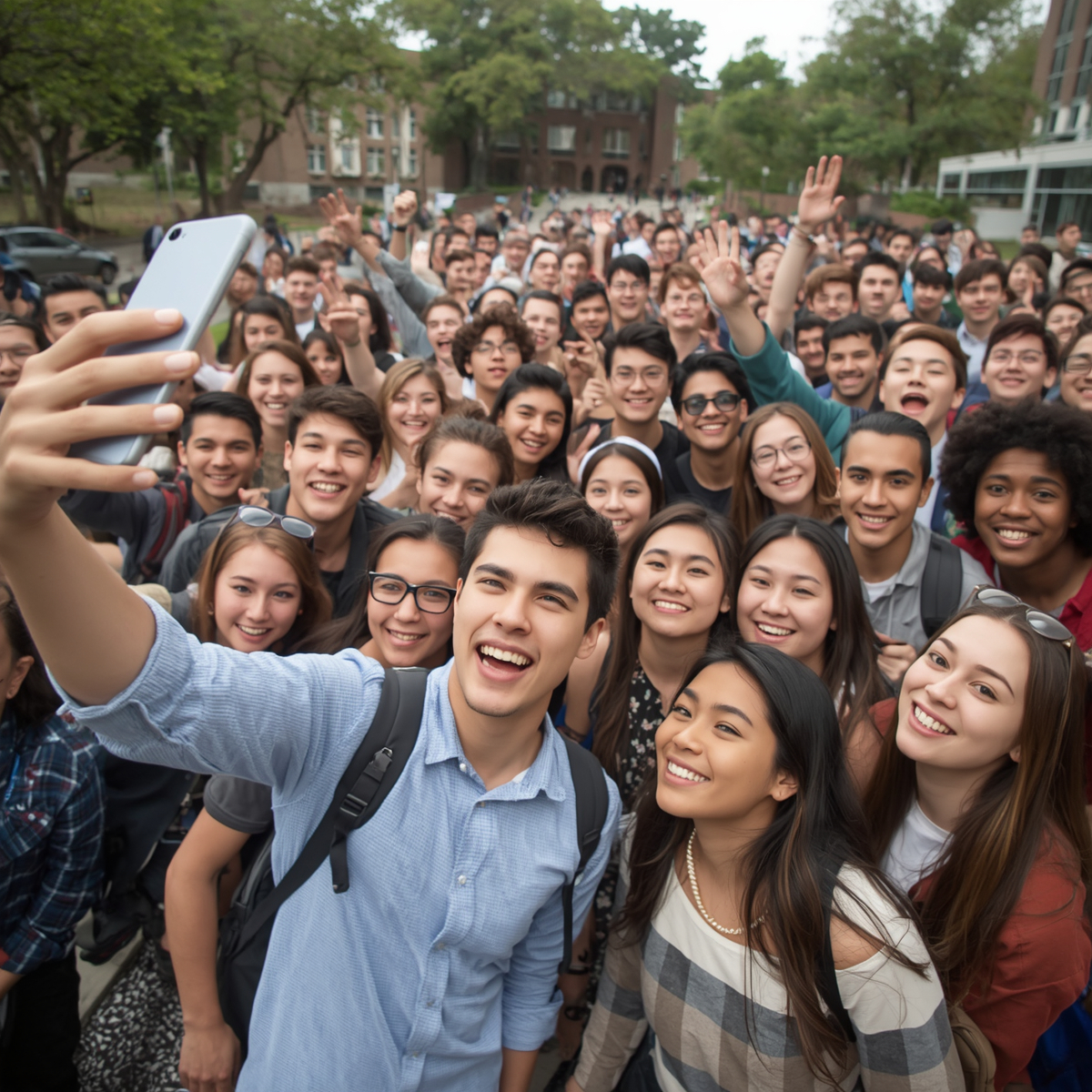
    A large diverse group of college students on campus taking a group selfie

    The 100 Creators Theory · A Programmatic Model

    What happens when 100 student creators post 3× a week for a year?

    A decentralized media force that compounds SEO authority, AI citations, and CRM-qualified applicants — at a fraction of paid-acquisition cost.

    The Model at a Glance

    100 creators × 3 posts / week × 1 year

    The math behind a single cohort: a conservative projection of monthly content volume, impressions, engagements, and qualified CRM inquiries.

    Active Student Creators
    100
    Weekly Cadence
    3 posts per creator
    Monthly Content Volume
    1,290 posts (100 × 3 × 4.3 weeks)
    Monthly Impressions
    1,935,000 (≈1,500 avg views / post)
    Monthly Engagements
    154,800 (8% nano-creator rate)
    Monthly Qualified Leads
    4,644 CRM inquiries (3% conv.)
    Annual Pipeline
    46,440 qualified leads / 10-month cycle

    The Great Recalibration

    A static directory of profiles becomes an active, decentralized media force.

    When 100 student creators publish short-form video content three times weekly, they transition your student body from a static directory into a continuous storytelling engine — published in the algorithmic feeds where Gen Z already makes university decisions.

    In the current landscape of volatile policy changes, rigid visa caps, and tightening budgets, this programmatic model establishes a powerful organic and financial shield around enrollment.

    Section 1 · Traditional SEO

    The Google Paradigm: human-first signals replace AI slop.

    Google's core updates favor authentic, experience-driven content. A continuous, decentralized volume of student-produced media changes Google's technical evaluation of your brand.

    Unlinked Brand Mentions & Entity Authority

    Google places immense weight on unlinked brand mentions across high-authority platforms (Instagram, TikTok, Reddit). 100 creators generate the high-frequency social noise that promotes your university's node in Google's Knowledge Graph from an unverified website to a Validated Real-World Entity.

    Multimodal Audio Indexing

    Googlebot processes and indexes the audio transcripts of TikToks and Reels. When creators vocalize key terms (e.g. 'computer science co-op,' 'nursing clinical placement') in the first 5 seconds, those transcripts are pulled into mobile video carousels at the top of search.

    The Reddit 'Real-Time Truth' Shield

    Google's $60M Data API partnership with Reddit puts community threads at the top of organic results via Discussions and Forums. When creators address applicant questions in relevant subreddits, those threads bypass ad blocks and capture high-intent prospects looking for peer validation.

    Hyper-Local Geographic Clustering

    Mandating cohorts to tag exact campus nodes — academic halls, labs, student unions — maps precise geo-coordinates, letting the university naturally dominate regional search packs around its locality.

    Section 2 · Generative Engine Optimization

    The AI Paradigm: dominate ChatGPT, Gemini, Perplexity & AI Overviews.

    Generative AI search platforms compile answers by parsing human discussions across the open web, heavily prioritizing structured, conversational evidence.

    Surging Citation Frequency

    The primary metric of GEO is citation frequency — how often AI engines reference your brand. Ahrefs' 75,000-brand study found branded web mentions have the strongest correlation with AI Overview visibility (coefficient 0.664), far outperforming traditional backlinks.

    Co-Citation Training & Neural Mapping

    When creators repeatedly discuss your university alongside phrases like 'career-ready experience,' 'post-grad placement,' or 'hands-on degree,' LLMs update their internal neural layers to treat your institution as a core recommendation for those category-level prompts.

    Crawlable Social-Proof Hubs

    AI bots crawl structured glossary, definition, and 'VS' comparison pages up to 3.2× more frequently than other digital assets. Repurposing creator stories, transcripts, and Q&As on your main domain in clean server-rendered HTML keeps AI crawlers continuously ingesting and citing your brand.

    Section 3 · The Funnel Math

    From posts to qualified applicants — in four steps.

    Nano-creators (1,000–15,000 followers) command the highest audience trust thanks to their "Digital Best Friend" persona. Mobilizing 100 of them at 3 posts a week yields a predictable, high-converting recruitment engine.

    1. 01

      Step 1 — Media Output

      V_M = C × P × W

      C = 100 creators, P = 3 posts/week, W = 4.3 weeks/month

      → 1,290 posts per month

    2. 02

      Step 2 — Impressions

      I_M = V_M × V_avg

      V_avg = 1,500 views/post (interest-graph networks)

      → 1,935,000 monthly impressions

    3. 03

      Step 3 — Engagements

      E_M = I_M × R_E

      R_E = 8% conservative nano-creator engagement

      → 154,800 hand-raiser interactions / month

    4. 04

      Step 4 — Qualified Leads

      L_M = E_M × R_C

      R_C = 3% baseline engagement-to-lead conversion

      → 4,644 CRM inquiries / month · 46,440 / 10-month cycle

    Pipeline Snapshot

    Monthly funnel projection

    Funnel StageMonthly ProjectionPipeline Impact
    Media Output1,290 postsFloods regional feeds with unpolished peer storytelling.
    Impressions1,935,000 viewsGenerates massive brand awareness across TikTok/Reels.
    Engagements154,800 interactionsCaptures comments, saves, shares, and link-in-bio clicks.
    Qualified Leads4,644 CRM inquiriesDelivers pre-screened, warm leads directly to your CRM.

    Lead Quality

    Why these leads are structurally superior to paid ads.

    Regulatory & Visa Compliance

    Prospective applicants spend weeks consuming authentic vlogs detailing academic expectations, housing, and financial realities. They match the high-integrity applicant profile demanded by immigration authorities — protecting your sponsor license and satisfying thresholds like the UK's proposed <5% visa refusal rate.

    Bypassing High-Commission Middlemen

    In destinations like the UK, traditional agents are involved in 50–70% of international enrollments, charging 10–15% — or up to 30% — of first-year tuition. A structured student-led creator network generates direct-to-institution interest, driving cost per enrolled student down to £320–£500.

    Fostering a Sense of Belonging

    Traditional marketing shares raw facts; student creators share lived experiences. Building peer-to-peer trust inside the algorithmic feeds where Gen Z already lives speeds up application velocity and lifts final yield.

    Peer-Led vs. Paid Acquisition

    How the model compares to traditional paid digital advertising.

    MetricPeer-Led Creator NetworkTraditional Paid Ads
    Cost per Lead£320–£500$982 (industry avg.)
    Inquiry Loss RateLow — peer-verified intent~60% drop-off
    Agent Commission ExposureDirect-to-institution10–30% of Yr-1 tuition
    Visa Refusal RiskPre-screened 'Prepared Student'High — under-informed applicants
    Lead TypeWarm, hand-raisedCold form fill

    FAQ

    Frequently asked questions

    Why 3 posts per week per creator?

    +

    Three posts is the cadence that algorithmic feeds (TikTok, Reels) reward with sustained reach without creator burnout. It produces enough surface area to compound entity signals weekly while remaining sustainable for full-time students.

    Where do the 1,500 avg views, 8% engagement, and 3% conversion numbers come from?

    +

    1,500 views/post is a conservative baseline for nano-creators on interest-graph networks where view velocity is decoupled from follower count. 8% reflects published nano-creator engagement benchmarks, and 3% is a conservative engagement-to-qualified-lead conversion based on peer-led inbound funnels.

    How does this affect Google rankings vs traditional SEO?

    +

    It updates Google's entity graph for your institution via unlinked brand mentions, audio transcript indexing, Reddit Discussions surfacing, and hyper-local geo-clustering — signals that compound where backlink-only strategies plateau.

    What's the difference between SEO and GEO?

    +

    SEO optimizes for traditional search engines indexing pages. GEO (Generative Engine Optimization) optimizes for AI answer engines (ChatGPT, Gemini, Perplexity, AI Overviews) that compile responses by parsing human discussions and citing brands frequently mentioned in conversational evidence.

    How quickly will we see CRM inquiries?

    +

    Programs typically see warm inbound CRM inquiries within the first 30–60 days as creators publish, with the full funnel maturing across an academic cycle as audio indexing, Reddit surfacing, and AI citation frequency compound.

    See the projection for your institution.

    Plug in your own cohort size, post cadence, and target market — and see the SEO, GEO, and CRM pipeline you'd build over a single academic year.